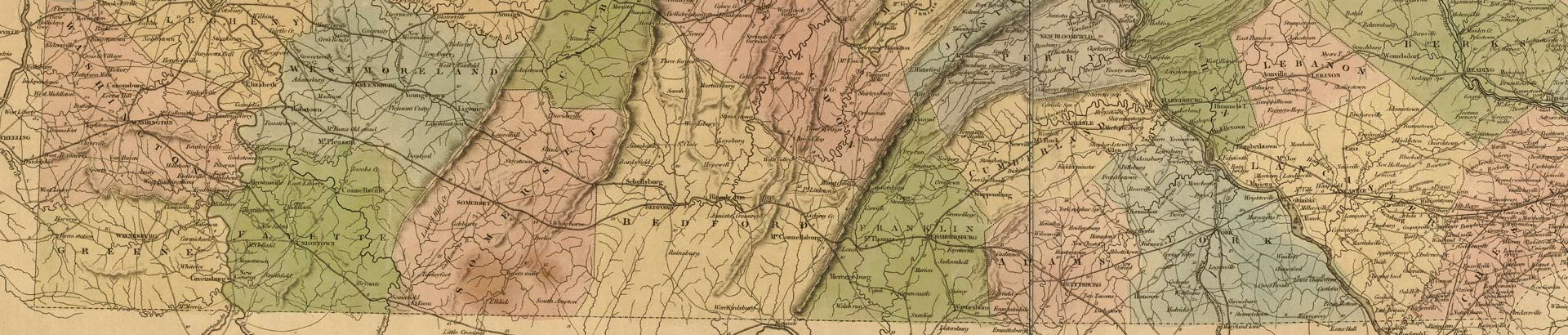
This photo shows an 1839 map of Pennsylvania from the Library of Congress.
Chapter 11
Roy Dietle s Memories of Growing Up in Somerset County
Written by Dana from conversations with Dad24,135
As a little boy, Dad (Roy E. Dietle) would help the family make hay, hoping all the while that it would rain. Grandpa, June, and Bud would fork the hay onto the wagon while dad stomped it down. Once the wagon was full they took it to the barn to unload it. In the barn there was a hay fork on a track which would pick up the hay and carry it to the back of the barn, where the boys scattered it about. After Ralph was old enough to stomp hay on the wagon, Dad graduated to forking hay onto the wagon. Dad recalls that when they were in the field working, Grandpa could tell when it was noon, and time to go back to the house for lunch, by when he could place his foot on the head of his shadow.
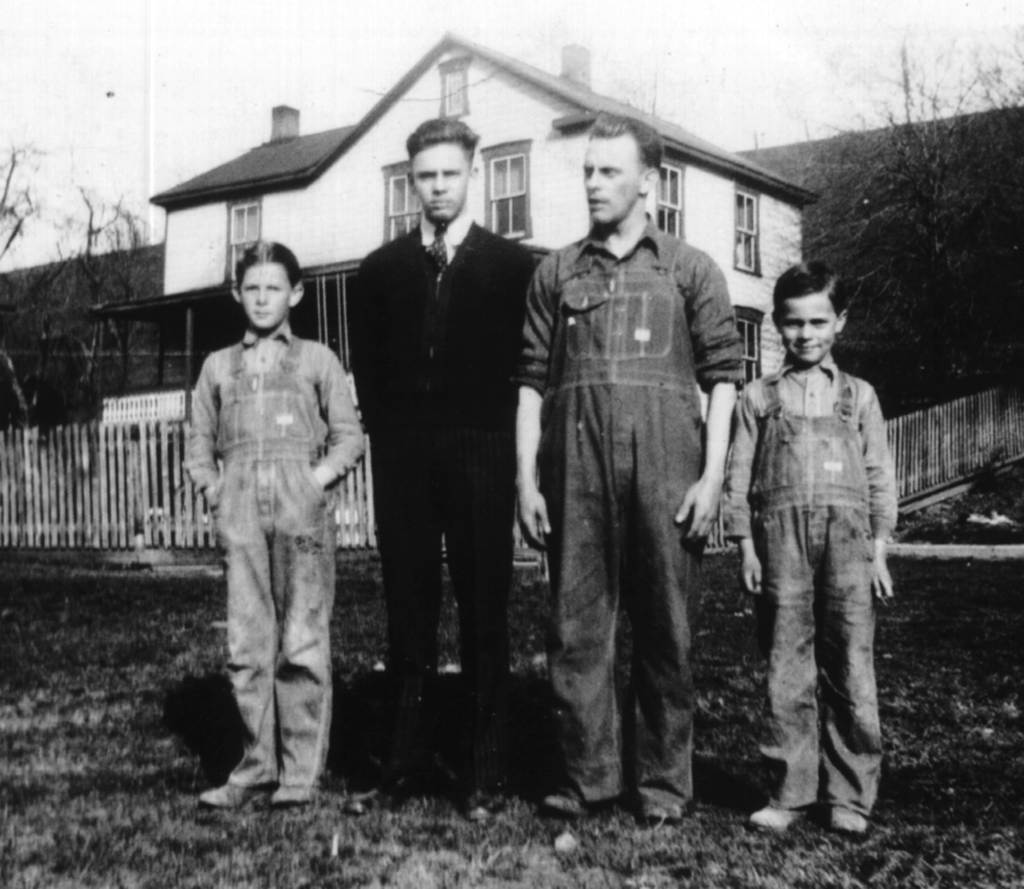
This is my favorite picture of Grandpa Irvin Dietle. He is posing with his sons in front of his Larimer Twp. farm house, which was once owned by Ephriam Geiger. Note the full length porch on the front of the house, and the steep hill which comes right up to the back of the house. This house once belonged to Ephriam Geiger. L to R: Irvin, Jr., Luther, Irvin, Sr., Roy.
Back then Grandpa (Irving H. Dietle) grew 2-3 acres of potatoes and 5-6 acres of sweet corn for resale. The corn was planted with a planter, then picked by hand and sold to a cannery in Somerset. The potatoes were planted and picked by hand, then huckstered (peddled) in Mt. Savage, Wellersburg, and Barrelville. Dad remembers going door to door when he was little and asking families if they wanted to buy potatoes. Grandpa also raised wheat, oats, rye and field corn. (During WW-II Grandma used rye to make ersatz coffee by browning it the oven before boiling.) The grain was harvested by shocking it by hand, then taking it to the barn to wait until the threshing machine could come by the farm. (I can remember helping shock grain at Grandpa s circa 1965. L.D.) The corn was cut, shocked and husked by hand, then taken to Sam Baer s feed mill to be ground into cattle feed, cob and all. Dad remembers riding a horse to cultivate the corn field. He had one cousin who always liked to ride the horses at the fair. Dad wouldn t go with him because dad had more than his fill of riding horses on the farm. Grandpa also raised chickens, hogs, beef cattle and Brown Swiss dairy cows. The beef were raised for sale. Sometimes Grandpa took the Brown Swiss to the fair to show them, and did pretty well. The hogs were customarily butchered on Thanksgiving or the last Saturday in November. Dad s Uncle John and Uncle Simon came with their families to help with the butchering, then Grandpa and Grandma would reciprocate by taking their family to help John and Simon butcher.
In 1930 Grandpa and Grandma had a hand pump installed in the kitchen. This meant no more hauling water from the spring for cooking, cleaning, drinking, and washing clothes. They had a coal heating stove in the living room and a cooking stove in the kitchen. Grandma was a very good cook, and for many years cooked on a wood and coal burning stove. In 1940 they had electric connected to the house. In 1941 they had a coal steam boiler added for heating, and before long they had also a gas stove. They got their first refrigerator circa 1948/49. The new refrigerator meant that they no longer had to hand carry food and milk to and from the spring house for preservation.
Grandpa s family were devoted members of the White Oak Mt. Carmel Lutheran Church. In the wintertime, if the snow was too deep to drive the mile and a half to church, the family walked. One time their 1932 Chevy went down over a hill and turned over, and they had to get the team of horses to pull it out. Before the 1932 Chevy, Grandpa had a 1928 Chevy, and before that a Model T Ford. After the 32 Chevy, Grandpa had a 1936 Chevy, which he traded in on a 2 door 1940 Chevy which had a sticker price of $611.00. The three oldest boys learned to drive in this car, which Grandpa had to keep for a long time due to WW-II and the post-war demand for cars. His next car was a 1949 Dodge, and all of his remaining cars were also Dodges; a maroon 53, a pink & black 56, a 58, a maroon 65, and a green 73.
When dad was growing up, one thing the family liked to do together was drive to the fire tower that was about halfway to Berlin, and see if they could pick out the farm. They also liked to go to parades in Meyersdale. Sometimes the whole family would go to Grandma and Grandpa Miller s home in Greenville Township for Sunday dinner, where there were lots of other kids to play with. Dad and Grandpa often would go for walks together in the woods on Sunday afternoon.
Usually once a year, after the sweet corn was ready, they held a corn and weiner roast near the stump fence on Grandpa Dietle s farm. The stump fence was located in the meadow about 100 yards behind the garden in the direction of the White Oak Church. The fence was made up of stumps which had been pulled for clearing, and the stumps were used in the evening fire. Dad s Uncle John and Uncle Simon and their families came, and possibly others. It was at this event that dad recalls eating as many hot-dogs as he was old. The fire was started in the late afternoon, and then the families spent the whole evening together sitting around the fire and talking, with the fire as a focal point in the darkness. Dad recalls these campfires with great fondness, and he likes to renew the evening campfire tradition whenever his friends and family come to visit his home.
Another social event which the family attended was the White Oak Picnic, which was an affair held jointly by the White Oak Reformed and Lutheran Churches. The two churches split the profits. The picnic was held on the third or fourth Saturday in July. They started setting up around 10:00 AM, and by 11:00 AM many people from miles around were there. The folks would bring a picnic lunch and eat together. After lunch there were games for all ages. In some games, you divided up by age, and the winner would win a prize, such as a box of Cracker Jacks. There were also games where one paid to play, such as one where a watermelon was placed on the ground, and if you could hit it blindfolded with a wheel-barrow you won it. Also, you could pay to join the cake walk, where everyone walks in a circle past a cake while music played. When the music stopped, the person closest to the cake won it, but everyone got to enjoy a piece of the cake. Sam Baer brought a big sliding board for the kids each year. The picnic had a bandstand with music and singing. There was also a shop (as Dad called it) where ice-cream cones, hot dogs, hamburgers, candy bars, Cracker Jacks, balloons, paddle-balls, and so forth were sold. (When I was growing up, this was popular with the kids. The first paddle ball I ever saw was from the White Oak picnic. I can remember being very envious of the cousin who had it! LLD) When evening came, the men would go home to do their barn work, and then come back. In the evening, the teenagers would go into the church lot and play more games, such as Drop the Hanky, Fly Dutchman, etc. After a fun-filled day, everyone would head home. The next day after church and Sunday-School, the kids would go over to the Shop and look for lost coins in the wood chips around the shop.
Descendants of Johann Adam Dietel of 19th Century Somerset County, Pennsylvania
Chapter 1: GGG-Grandparents Adam Diettle & Mary Ann (Unknown) Diettle
Chapter 2: Nicholas Dieddle & Mary (Rembold) Dieddle, Ancestors of the Deitle Family Branch
Chapter 3: Descendants of Nicholas Dieddle & Mary (Rembold) Dieddle
Chapter 5: Descendants of John Adam Dietle & Margaret (Ritter) Dietle
Chapter 6: Great-Grandparents Adam Dietle & Susan (Werner) Dietle
Chapter 7: Descendants of Adam Dietle & Susan (Werner) Dietle
Chapter 8: Grandparents Irvin H. Dietle & Alma C. (Miller) Dietle
Chapter 9: Descendants of Irvin H. Dietle & Alma C. (Miller) Dietle
Chapter 10: History of the Dietle Surname
Chapter 11: Roy Dietle's Memories of Growing Up in Somerset County
Chapter 12: Beginner's Luck; The Story of Roy Dietle's First Deer
Appendix A: Miscellaneous Individuals and Families
Appendix B: Somerset County Legal Transactions
Appendix C: Wanderbuch of Johann Adam Dietel
Appendix D: Report Card of Erdmann Dietel von Bernech
Appendix E: Miscellaneous Documents & Photographs
Addendum A: Corrections and Additions
Additional information and supplementary materials can be found at Lannie Dietle's website.
Return to the standard version of the website.