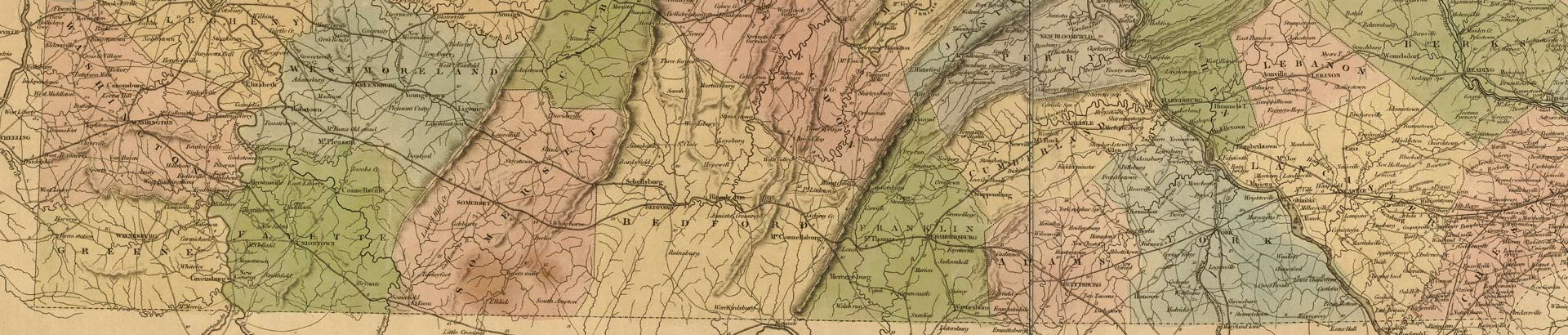
This photo shows an 1839 map of Pennsylvania from the Library of Congress.
Chapter 10
History of the Dietle Surname
Early U.S. Spelling Variations
As documented in the first few chapters, the surname of our immigrant ancestor and his sons is spelled many different ways in the surviving records, including Dietle, Deitle, Dietel, Diettle, Deittle, Dieddle, Deitle, Deutle, Deetle, Detel, Tietle, Tietel, Deatle, Tittle, Dittle, Diddle, Dieddle, Diedle, Diettel, Deatte, and Deate. Such wide spelling variations are common in many German-American families which immigrated in the 18th and 19th centuries. Sometimes immigrants intentionally attempted to Anglicize their surname to disguise German origin, or to make the name easier for their fellow Americans to spell phonetically using English spelling conventions. Sometimes census takers, ministers, lawyers, tax collectors, etc. entered a name into a record carelessly, or just spelled it the way they thought it sounded, rather than inquiring as to how it should actually be spelled. Immigrants have also been known to be illiterate, and not actually know how to spell their own name. All of these factors may have played a role in the many different spellings of the Dietle family name which are present in the documents of record. The variations in the old records are not surprising to anyone who has done genealogical research, nor should they come as a surprise to those who bear the Dietle/Deitle name today, for who among us doesn t regularly receive mail with corrupt spellings? The phone company just sent our household a letter addressed to Dedall , for example!
American Pronunciation
The American descendants of Johann Adam Dietel which I have spoken to seem to pronounce the name Dee-tull or Deed-ul. In my opinion, when asked how to pronounce the name, we carefully enunciate Dee-tull with a somewhat awkward t sound in the second syllable, however when we say it quickly without thinking about it so much, we (again, in my opinion) actually pronounce it Deed-ul , which is a little easier to say.
At least one other American family with the spelling Deitle (but no known relation to us) pronounces the name Dye-tull with the ei in the first syllable pronounced eye 191. The family member who I spoke to said that in German, the ei and ie sounds are backwards, meaning ei is pronounced eye and ie is pronounced the same as the e in he191. Another American family, with the spelling Dietle (but no known relation to us) also pronounces the surname as Dye-tull , with the first syllable having a long i sound171. Another family in Michigan pronounces Dietle as Deet-Lee 170.
Current Spelling Variations
Given the many surname spelling variations encountered in the first two American generations, it is amazing that there are now just two stable variations among Johann Adam Dietel s descendants. The descendants of his son Nicholas use the spelling Deitle , and the descendants of his son John use the spelling Dietle . The exact reason for these two spellings cannot be known perfectly, but surviving records and stories do provide insight. It appears that at one time there was a concensus to use the name Deitle in order to facilitate pronunciation, then part of the family changed to Dietle in order to retain German spelling.
Grandpa Irvin H. Dietle told his son (our father) Roy E. Dietle that he changed the family name from Deitle to Dietle because of advice he received from a professor who knew something of German spelling and who informed Grandpa that in Germany the name would have been spelled with ie rather than ei . In the 1923-24 School Report of Somerset County, Penn a., Grandpa Irvin s last name is spelled Deitle376, and our dad has told us that on his own birth certificate the name is given as Deitle . Since Dad was born on Jan. 3 1932, Grandpa must have changed the name from Deitle to Dietle some time after that. As I understand the story, Grandpa first changed the name from Dietle to Deitle, and then back to Dietle. This is supported by the record of his Teacher s Provisional Certificates 387; the name on the 1917, 1918, 1919, and 1923 certificates is spelled Deitle , while the 1915, 1916 and 1932 certificates have the spelling Dietle .
Darius Dietle reports that I heard the name change from Deitle to Dietle was by a school teacher in the Dietle family (who) said that the i comes before e except after c and that is where we get the Dietle name. 21 This account may relate to our Grandfather Irvin H. Dietle, who was a school teacher, and who was known personally by Darius s father.
Edna (Dietle) Kimmel did not know how the name came to be spelled two ways, but did express the belief that German ie names are expressed ee , and ei names are prounounced eye 461.
Mrs. Chuck Deitle says that her husband was told that his grandfather or Great-grandfather didn t like the name being mispronounced as Dye-Tell in America, and inquired as to how to alter the spelling to achieve the correct pronunciation of Dee-Tull, and followed someone s suggestion of swapping the ie to ei189. This seems plausible, because one genealogical handbook indicates that Germans were usually concerned more about correct pronunciation than spelling141. Chuck s grandfather was Herman, and the name on Herman s tombstone is spelled Deitle 315.
When I talked to Roy E. Deitle (son of James) in April of 1994, he said that his dad or grandfather (he thought it was his grandfather) used Dietle, but didn t like it being pronounced Dye-tell, so he changed it to Deitle so that people would pronounce it Dee-tull. This agrees with the story related above by Mrs. Chuck Deitle.
Vivian Timblin180 remembers a tradition of a disagreement over the spelling of the name, but doesn t remember any details. She remembers hearing Herman Deitle and Jake Paul* sitting in the kitchen and discussing how the name should be spelled. Jake Paul had a sawmill across the road from Herman Deitle s driveway. (She remembered going back many years later and seeing that the remains of the sawmill were still there.) She said there was quite a discussion over the spelling. She lived there at Herman s as a child, and visited in the summers and heard this conversation personally. She elaborated and said that in the discussion, Herman said that his father Nicholas spelled the last name Deiddle (which is supported by records), but Herman thought that was too long180. She said somebody came up with the spelling Dietle and Herman spelled his name that way for awhile180. This is supported by surviving records. For example, in the 1920 census results from Greenville Twp.4, Herman s last name is spelled Dietle , and in the 1910 census results, his father Nicholas s last name is also spelled Dietle 51.
Vivian s story is supported by a telephone conversation that our father Roy Dietle had with James Deitle s son Roy Deitle. In that conversation Roy Deitle related a tradition of an argument that led to the Deitle spelling.
In a 1947 letter of genealogical inquiry, Mrs. Margaret (Deitle) Beutel referenced her Grandfather as Nicholas Deiddle, and stated Who revised the name here is unknown to me.................our name was spelled either way, Dietle or Deitle189. By comparing these oral traditions handed down in the several branches we probably understand the name change better than Margaret, but the actual details of the early evolution of the spelling remain lost to time, just as they were in 1947.
Etymology
The ancient history of the name has been very difficult to pursue because of the barriers of language, distance and time. There are three books we have encountered which are written specifically on the topic of the origin and history of German surnames. Unfortunately, all three are written in German, and to make matters worse, they are very cryptic, heavily abbreviated and difficult to comprehend, even for those who understand written German. We have, with the translation help of others, attempted to develop an understanding of what these German family name books say about our surname, and our understanding is presented below. Please recognize that there is no proof that the etymological information in any of the 3 books applies specifically to our family bloodline, for there very well may have been a number of independent families with similar names but no direct blood relationship.
The Familiennamenbuch443 (Family Name Book) groups the names Diet(e)l, Tietel, and Tittel together under the same surname entry. Douglas M. Addison interprets this as meaning that they are alternate forms of the same name446. The initial part of the Familiennamenbuch entry for Diet(e)l, Tietel, and Tittel reports on information provided in three other sources, as follows:
(1) The Familiennamenbuch first states that according to the Hans Bahlow Deutsches Namenlexicon 1361 Dityl = Diterich luerlin 443 . More on this below.
(2) The Familiennamenbuch next states that according to E. Schwarz in Sudetendeutsche Familiennamen aus vorhussitischer Zeit, 1957 (Southern German family names prior to the Hussiten), the name Ditel was known in 1384. Ingrid Bender of Houston, TX reports that her German encyclopedia indicates that the Hussiten were followers of Johann Hus, members of an anti-feudal movement of Tchecks445. She notes that there were fierce battles in the Hussiten wars of 1419-1436, causing much destruction, and that the Hussiten moved through Austria, Selesia, and Sachsen445.
(3) The Familiennamenbuch also states that according to V. Hellfritzsch in Vogtl ndische Personennamen (First Names in the Vogtland), an examination of materials in the area of the towns of Plauen and Oelnitx (Berlin: German Slavic Research of Origins of Names and Settlement History, 1963), the name was seen as Dittl in 1460. From the Familiennamenbuch entry, it is unclear to me if this is a 1460 reference to a first name or last name.
According to Douglas M. Addison, the Familiennamenbuch indicates that the surnames Diet(e)l, Tietel, and Tittel are shortened forms of the first name Diederich or similar old German names which begin with the old high German word thiot/diot which means people or folk446. The thiot/diot beginning is coupled with helm to produce the complete name Diet(e)l/Tietel,/Tittel446. The literal translation for Helm is helmet446,445,448, but it implies strength446, as in force448, might448, strength446 and power446,448, or ruling446, administrate448, and reigning446. To sum this all up in my own words, in my opinion it seems that Familiennamenbuch may be saying that our surname may mean something approximately like People Power or People Leader . The Familiennamenbuch also briefly notes that in middle high German, the word t tel is a diminutive of teat or nipple, and t teln means to flatter445.
Ingrid Bender also notes that the modern day German word titel has the same meaning as the English word title 445. My German-English dictionary uses titel in the sense of form of address, such the title one should use when addressing a Bishop450.
The Hans Bahlow Deutsches Namenlexicon444 groups the names Dietel, Dietlein*, Dietle, and Dietl together under the same surname entry. The complete entry reads Dietel, Dietlein, Dietl (obd) = Dietrich, auch Diethelm u. . Dityl=Diterich luerlin 1361 Brsl. Patronym: Dietler (vgl. Seidel: Seidler). It is difficult to extract much information from the cryptic text Dityl = Diterich luerlin 1361 Brsl , but it seems to at least indicate that as early as the year 1361 a name similar to ours existed in the form Dityl , and had some relationship or equivalency to the name Diterich. According to the Bahlow abbreviation key, Brsl is an abbreviation for Breslau. According to Ingrid Bender, Diterich is an old German spelling of a male first name, but she didn t know what luerlin meant445. Robert E. Ward of Fairview, OH, who has access to Bahlow, states luerlin is the surname. Diterich is the first name. A Ditrich Luerlin was living in 1361. Today all surnames are capitalized. Back then, in medieval German, they were not. The Bahlow abbreviation key does not state what = means, however it may mean the same thing established for = in the 1857 book named Etymologisches Worterbuch der Deutschen Familiennamen447 i.e. gleich , which according to Ref. 450 means harmony, accord, equal to, or to match. Bahlow also indicates that Dietler is a patronymic** just as Seidler is a patronymic of Seidle. According to the Bahlow444 abbreviation key, (obd) stands for oberdeutsch , wich means Upper, or Mountain German 453. According to Robert Ward, u. . means among others and vgl. means compare .
Bahlow444 also has a separate surname entry for Dietle(in) which reads Dietle(in) s. Dietel! Dietleip (obd., Steiermark), Held er Dietrich-Sage, s. ndd. Detlef! . Ingrid Bender indicates that the in portion of Dietle(in) refers to feminine445. I can t make much out of this entry. The Bahlow abbreviation key indicates that ndd means niederdeutsch , and s. stands for siehe which means sight, vision, see. Niederdeutsch means low German , which is a term for a German dialect spoken only above the so-called Benrath line453.
Etymologisches Worterbuch der Deutschen Familiennamen447 has two entries, one for Dietel, and one for Dietle(in). The entry for Dietel reads in it s entirety Dietel < VN Diet(rich). 1523 Seb. Dietell, Pleban zu Lorch: WV. (NF.) XI, 264. According to the abbreviation key in Etymologisches447, < means from or out of and VN stands for Vorname which means first name451. I believe that Dietel < VN Diet(rich) clearly means The family name Dietel originates from the first name Dietrich. The remaining part of the entry 1523 Seb. Dietell, Pleban zu Lorch: WV. (NF.) XI, 264. is less clear. Franz X. Fackler451 of Muenchen, Germany and I are of the opinion that Seb. stands for the first name of Sebastian. It is clear that other surname entries in this book use an abbreviated first name, so Seb. is pretty sure to be an abbreviation for a first name. Seb is unlikely to be an abbreviation for a German word, because there are no German words beginning with Seb in my 280,000 entry German dictionary450. I don t know for sure what Pleban zu Lorch means, but it sounds like it may possibly be some kind of position title. Zu means to and Lorch is a town name, and Pleban may refer to common man, as similar words do in Latin, German and English. There are two towns named Lorch on my Freytag & Berndt map of Germany, one which is west of Stuttgart near Schw bisch Gmund, and the other which is east of Frankfurt near a river. WV. (NF.) XI, 264. is a reference to a regional history quarterly, Wurttembergische Vierteljahrshefte fur Landesgeschichte that was printed in 1892. Robert Ward believes the phrase Pleban zu Lorch means a person from Lorch 449. Ernst Hoffman of St. Augustin, Germany says I have seen the term Pleban used to denote that priest in a chapter who was tasked to deal with the lays being subject to that monastery 452.
The Etymologisches Worterbuch der Deutschen Familiennamen447 entry for Dietle(in) reads Dietle(in), Koseform < Kurzform Diete, s.d. 1425 Joh. Hagnau gen. Dietlein zu Markdorf: REC. III Nr. 9104, u.a. The entry Dietle(in), Koseform < Kurzform Diete indicates that Dietle(in) is a short form or endearment for Diete, or possibly vice a versa it s not completely clear to me. Koseform means an affectionate or familiar form of a proper name and it has a feminine connotation450. Kurz means shortened and form is the same in English and German450. According to Ingrid Bender s interpretation445, 1425 Joh. Hagnau gen. Dietlein zu Markdorf: REC. references Johann Hagnau, reigning bishop of Constantiensium in 1425, who was known as Dietlein at a town named Markdorf. According to the abbreviation key in Etymologisches447, REC stands for Regesta episcoporum Constantiensium , which Ingrid interprets to mean reigning bishop of Constantiensium, which was an empire. u. a. means and others (et. al.)451 or among others . According to Franz X. Fackler, s.d. means look there 451. The Etymologisches447 abbreviation key indicates that s.d. means Siehe diesen Artikel . My dictionary450 indicates that siehe means sight, vision, so Siehe diesen Artikel must mean something like see this article, entry or item . Franz X. Fackler thinks that gen stands for genannt which means also called 451. the abbreviation gen could also be short for genitive , meaning showing possession, source, or origin.
German Place Names
Daryl Dietle reports that when he was in Germany in 1968, he was in a town named Dietl 177; however we don t know if this town has any actual link to our family. There are also several other towns which incorporate Dietl in their names, such as Dietlas in Bad Salzungen County, Th ringen, Dietldorf which is part of Burglengenfeld in Schwandorf County, Bayern, and Dietlingen, which is part of Keltern in Enzkreis (Pforzheim) County, Baden-W rttemberg439. The dorf suffix in Dietldorf means village 440. The ig portion of the igen suffix in Dietlingen translates roughly as the English y ; for example durst, durstig in German is thirst, thirsty in english441. The en portion of the igen suffix in Dietlingen is a gender based German word ending441.
Wappen
The German term for coat of arms is Wappen , a low German word meaning Weapon 453. In the German book titled Die Wappen b rgerlicher Geschlechter Deutschlands und Schweiz454 are found four different Wappen for families with surnames similar to ours. These Wappen are shown below, along with the text (or a translation thereof) provided with them. The term b rgerliche Wappen relates to civil coats of arms, as compared to adlige Wappen which is in reference to nobility coats of arms, and b uerliche Wappen , which relates to the peasant use of coats of arms453. Please bear in mind that there is no proof that any of the Wappen shown hereafter actually apply to our family bloodline.
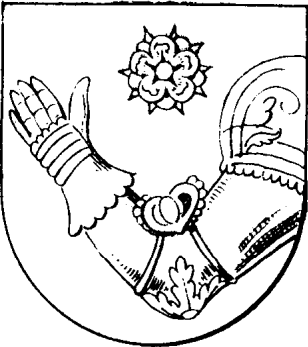
Ernst Hoffman s452 translation of Ref. 454 for the above Wappen: Dittel, Valentin, Pub-owner (or more likely house-owner < you need to check the local usage) came, as a craftsman, into the new council in 1548 . Ingrid Bender s456 translation of Ref. 454 for the above Wappen: Diettel, Valentin, Inn keeper at Augsburg changes from a group of skilled manual workers to the new council in 1548 . Joachim Schubert s460 translation of Ref. 454 for the above Wappen: Dittel, Valentin, innkeeper in Augsburg, joined the council as representative of the artisans.
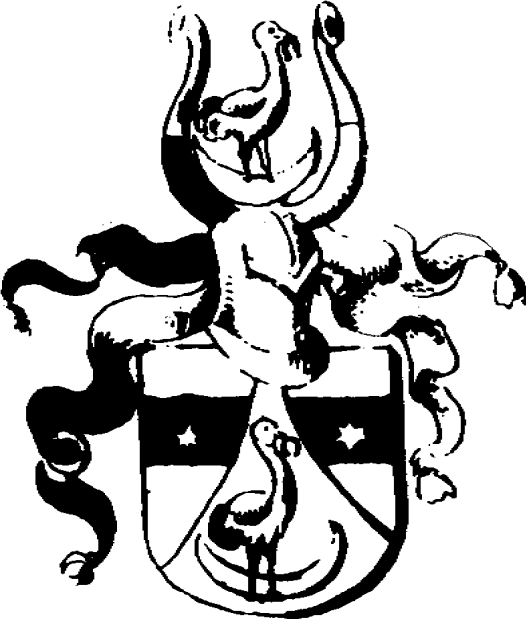
Ingrid Bender s456 translation of Ref. 454 for the above Wappen: "Dietl, Jacob died in Vienna (Wein) on April 28, 1609".
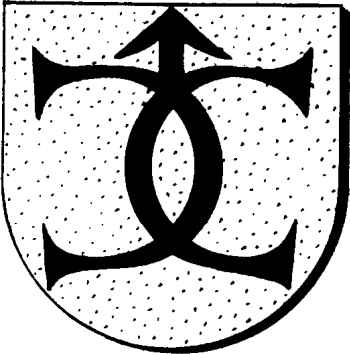
Ernst Hoffman s452 translation of Ref. 454 for the above Wappen: Diettel, Valentin from the livery-company of Salt-producers of the council at the city of Augsburg 1548 . Ingrid Bender s456 translation of Ref. 454 for the above Wappen: "Diettel, Valintin, of the guild of salt refiners from the council of Augsburg 1548." Joachim Schubert s460 translation of Ref. 454 for the above Wappen: Diettel, Valentin, member of the guild of salt merchants (4) of the Augsburg town council, 1548. Regarding the translation of the word Salzfertiger , Joachim460 says My guess for Salzfertiger. Salz is salt, while fertiger implies somebody who produces (or finishes) something. He must therefore have either produced or traded in salt, the second being more likely.
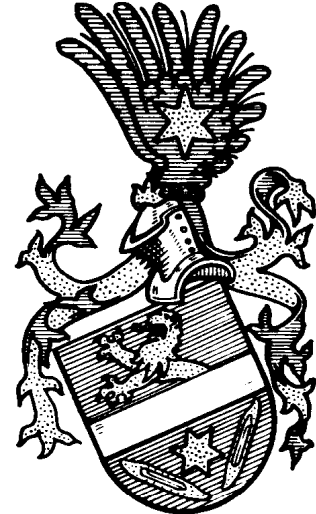
Ernst Hoffman s452 translation of Ref. 454 for the above Wappen: Dietel: protestant-Lutheran Family from the Vogtland (the south-western typ of Saxon), which first appears with Lorenz Dietl from Kloschwitz near Plauen in 1491. Since the Beginning of the 18.th century it belonged to the textile-industry of Greiz. It also has extended ("verzweigt" sic!) into academic professions. The princely Reus older line (=ae.L.) Real Secret Advisaor and President of the government (a local subdivison of the complete government) Theodor Dietl (born 1830 died 1900) became a hereditary nobleman in 1892. He was a cousin of the founder of Herman Dietel Inc at Graz. The "burgerliche" (=non noble) Coat of arms, which was adopted in 1941, was leaned on his (Theodor Dietl's) coat of arm by taking (Ubernahme sic!) the star over. Send in by Dr Alfred Lindner from Crimmitschau/Saxonia , Carolaplatz 4 < That adress is non existing today Carola of Wasa was a Queen of Saxonia) .
Ingrid Bender s456 translation of Ref. 454 for the above Wappen: "Evangelical Lutheran generation from the Vogtland (located in Sachsen) which first began in 1491 with Lorenz Ditell in Kloschwitz near Plauen. They belonged to the textile industry in Greiz since the beginning of the 18th century and later branced out into academic occupations. The dukely Russian (?), actual privy councilor and chief adminstrator Theodor Dietel (1830-1900), a cousin of the founder of the firm Hermann Dietel in Greiz, received heriditary nobility in 1892. Closely related to his (Herman Dietel's) coat of arms, is the middle class coat of arms of 1941, as described below, to which a star has been added."
Joachim Schubert s460 translation of Ref. 454 for the above Wappen: Dietel: ev. luth. family from the Vogtland; first appeared with Lorenz Ditell in Kloschwitz bei Plauen; involved in the textile industry of Greiz; branched out into numerous academic professions. Theodor Dietel (1830-1900), who was a cousin of the founder of the company Herman Dietel in Greiz, was an advisor (1) and president of the government for the House of the Princes of Reuss in the older line, and was raised to hereditary nobility in 1892. The common (2) coat of arms which was accepted in 1941 and which is described hereafter, was based on Theodor Dietels coat of arms by including the star. Submitted by Dr Alfred Linder, Carolaplatz 4, Crimmitschau, Saxony. Notes: (1) The actual title given here is difficult to translate. It is Wirklicher Geheimrat. A Geheimrat is a title for a burocrat or civil servant, while the Wirklicher implies that he actually was a civil servant, ie it was not an honorary title. He was therefore a true civil servant, but as he became government president, he must have been relatively senior. (2) common as opposed to noble. This refers to the coat of arms borne by the non-noble branch of the family.
* Jacob Paul lived on what was known as the George Warner (sic) farm 1/2 mile northwest of the Green ville Lutheran Church9. In the 1910 census51 his family is enumerated immediately after the Nicholas Dietle (sic) family. His wife Sarah was the oldest daughter of our GG-Grandfather Jacob Peter Miller9. He and Sarah are buried in the Greenville Union Cemetery315.
* Ingrid Bender speculates that Dietlein could possibly mean little Diet , since lein denotes diminuative.
** A patronymic is a surname developed from an ancestor s name by adding an affix which indicates descent, such as Davidson or MacAndrew.
Descendants of Johann Adam Dietel of 19th Century Somerset County, Pennsylvania
Chapter 1: GGG-Grandparents Adam Diettle & Mary Ann (Unknown) Diettle
Chapter 2: Nicholas Dieddle & Mary (Rembold) Dieddle, Ancestors of the Deitle Family Branch
Chapter 3: Descendants of Nicholas Dieddle & Mary (Rembold) Dieddle
Chapter 5: Descendants of John Adam Dietle & Margaret (Ritter) Dietle
Chapter 6: Great-Grandparents Adam Dietle & Susan (Werner) Dietle
Chapter 7: Descendants of Adam Dietle & Susan (Werner) Dietle
Chapter 8: Grandparents Irvin H. Dietle & Alma C. (Miller) Dietle
Chapter 9: Descendants of Irvin H. Dietle & Alma C. (Miller) Dietle
Chapter 10: History of the Dietle Surname
Chapter 11: Roy Dietle's Memories of Growing Up in Somerset County
Chapter 12: Beginner's Luck; The Story of Roy Dietle's First Deer
Appendix A: Miscellaneous Individuals and Families
Appendix B: Somerset County Legal Transactions
Appendix C: Wanderbuch of Johann Adam Dietel
Appendix D: Report Card of Erdmann Dietel von Bernech
Appendix E: Miscellaneous Documents & Photographs
Addendum A: Corrections and Additions
Additional information and supplementary materials can be found at Lannie Dietle's website.
Return to the standard version of the website.